
Structured Cabling Abu Dhabi: Cost, Standards and How to Choose the Right Contractor
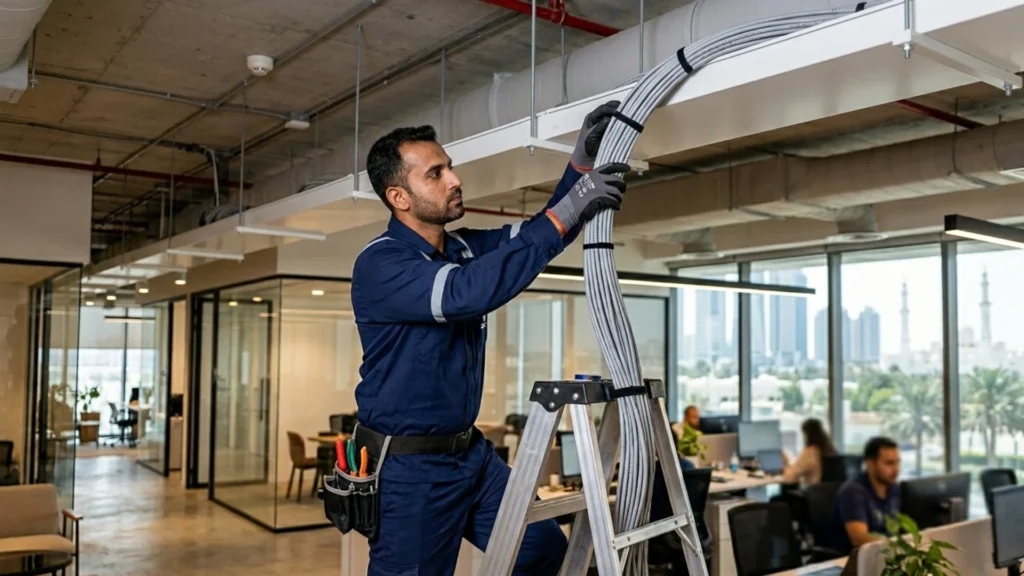
If your business is moving into a new office, expanding an existing facility, or upgrading an aging network, structured cabling in Abu Dhabi is the first decision you need to get right. Everything else, your internet connectivity, your CCTV system, your access control, your AV infrastructure, runs on top of it.
A poorly planned cabling system costs far more to fix than it does to install correctly from the start. Cables tucked behind walls, under floors, and above ceilings are not easy to replace once a building is occupied. This guide gives you the real numbers, the standards that matter, and the questions to ask before you sign with any contractor.
What Is Structured Cabling and Why Does It Matter in Abu Dhabi?
Structured cabling is a standardised system of cables, connectors, and hardware that forms the physical backbone of your entire network infrastructure. Essentially, it carries data, voice, video, and building system signals across your property through a single organised and fully documented framework. Because of this unified approach, businesses in Abu Dhabi gain a network foundation that is consistent, scalable, and fully documented from day one.
In Abu Dhabi, commercial and institutional projects must meet international quality and compliance standards, which means a structured cabling system is not a luxury. Instead, it is a baseline requirement for any serious commercial fit-out, government project, or mixed-use development. Furthermore, businesses that invest in structured cabling from the start avoid the expensive rework that point-to-point wiring almost always creates down the line.
Unlike point-to-point wiring, which runs individual cables for each device with no common framework, structured cabling uses a tiered architecture. Specifically, this architecture includes horizontal cabling from work areas to distribution points, backbone cabling connecting floors and buildings, patch panels for organised termination, and clearly labelled cable management throughout. As a result, every part of the system connects logically and is easy to identify, extend, or modify.
Ultimately, you get a system that your team can manage easily, troubleshoot quickly, and rely on for the next 15 to 20 years without major reinvestment.
Our IT network solutions team designs and installs structured cabling systems across Abu Dhabi for commercial offices, government facilities, healthcare buildings, and industrial sites.
Structured Cabling Standards You Need to Know in Abu Dhabi
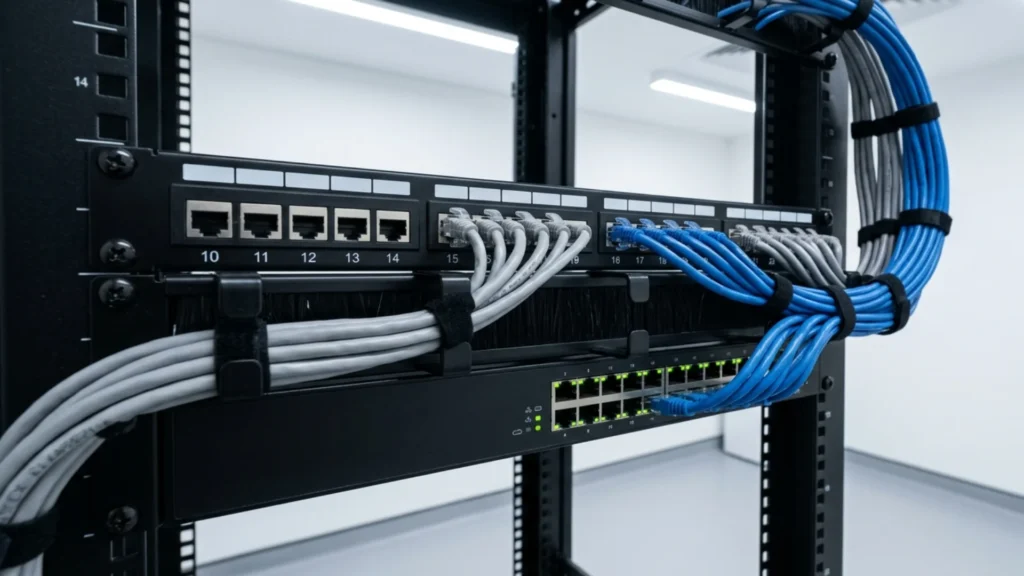
Before any contractor touches your building, you need to understand which standards govern the work. Structured cabling in Abu Dhabi must follow internationally recognised frameworks, and every qualified contractor knows them by name. If a contractor cannot name these standards clearly when you ask, remove them from your shortlist immediately.
BICSI Standards
BICSI cabling standards are the global benchmark for telecommunications infrastructure design and installation. BICSI-certified installers and designers follow a rigorous methodology that covers everything from cable routing and bend radius to documentation and testing. In Abu Dhabi, reputable ELV contractors hold BICSI qualifications as a baseline.
TIA-568 Standard
The TIA-568 structured cabling standard defines the technical specifications for commercial building telecommunications cabling. It covers cable categories, connector types, maximum cable run lengths, and testing procedures. Any structured cabling system installed in an Abu Dhabi commercial property should be designed and tested to TIA-568 specifications.
ISO/IEC 11801
The ISO/IEC 11801 international cabling standard is the global equivalent of TIA-568, used widely across European and international projects. Many Abu Dhabi government and institutional projects specify ISO/IEC 11801 compliance alongside or instead of TIA-568. A qualified contractor works to both.
Category Ratings Explained
Structured cabling uses category ratings to define performance. Category 6, or Cat6, supports speeds up to 1 gigabit per second and suits most standard office environments. Category 6A supports 10 gigabits per second and is the recommended choice for new installations in Abu Dhabi today, as it provides headroom for future network upgrades. Fiber optic cabling handles backbone runs, data center connections, and any application requiring very high bandwidth or long cable runs beyond copper limits.
Choosing the right category for your project is not about cost alone. It is about how your business will use the network five and ten years from now.
Structured Cabling Cost in Abu Dhabi: What to Expect
A small office of 10 to 30 workstations typically pays between AED 15,000 and AED 40,000 for a complete Cat6A system, covering materials, installation, testing, and documentation.
Medium commercial fit-outs of 30 to 100 workstations generally fall between AED 40,000 and AED 120,000, depending on floor count, ceiling access, and whether a data room is included.
Large commercial, healthcare, or institutional projects use a per-data-point pricing model. In Abu Dhabi, a fully installed, tested, and certified data point typically costs between AED 350 and AED 700, depending on cable category, containment type, and project complexity.
What Drives the Cost Up
Several factors push structured cabling costs higher in Abu Dhabi projects. First, raised floor or ceiling void access in occupied buildings increases labour significantly because installers work around existing furniture, staff, and infrastructure. Additionally, projects that require Fluke-certified testing on every run add cost, but they also give you documented proof of performance that unverified installations simply cannot provide. Furthermore, buildings with long cable runs exceeding 90 metres require fiber optic segments, which carry a higher material cost than copper alternatives. Finally, projects with tight timelines or phased occupancy demand more coordination from the contractor, and that additional complexity is always reflected in the price.
What to Be Cautious About in Quotations
A quotation that appears significantly lower than the ranges above usually signals one of three problems. Most commonly, the contractor uses sub-standard cable that does not meet Cat6A or Cat6 specifications. Alternatively, testing and certification are absent from the scope, which means you receive no proof that the system performs to the standard it claims. In other cases, documentation and as-built drawings are simply not included, and that absence creates serious problems every time you need to modify or expand the system later.
Always ask for a bill of materials with brand names, a testing methodology, and a sample of the as-built documentation you will receive on project completion.
Types of Structured Cabling Systems for Abu Dhabi Businesses
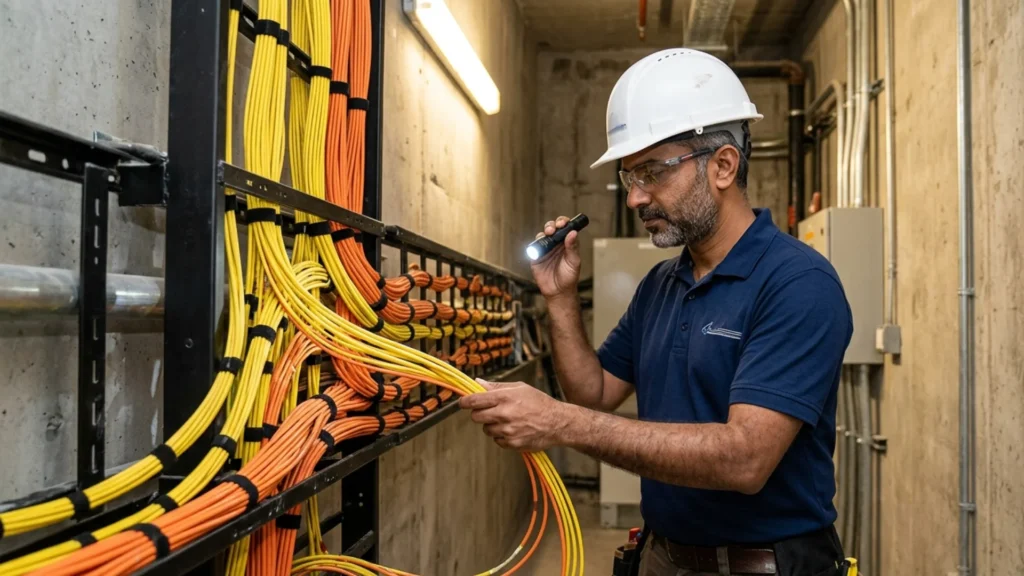
Not all structured cabling systems are the same. The right design for your project depends on how your building is used and what systems need to run across the infrastructure.
Copper Cabling Systems
Copper cabling, specifically Cat6 and Cat6A, covers the horizontal cabling layer in most commercial buildings. It connects individual workstations, IP phones, wireless access points, CCTV cameras, and access control readers back to the distribution point. Copper is cost-effective, widely available, and fully capable of supporting modern network speeds when installed correctly.
Fiber Optic Cabling Systems
Fiber optic cabling handles backbone runs between floors, between buildings, and into data rooms. It also serves applications requiring very high bandwidth or immunity to electromagnetic interference. In Abu Dhabi’s modern commercial developments, a hybrid system using copper for horizontal runs and fiber for backbone connections is the standard approach for any building over two floors or any campus-style environment.
Data Center and Server Room Cabling
Server room and data center cabling requires a structured approach separate from the general office network. High-density patching, cable management trays, hot and cold aisle containment, and MPO fiber trunks are common in Abu Dhabi data center environments. This is a specialist area where mistakes create downtime, and downtime is always expensive.
Integrated ELV Cabling
In Abu Dhabi commercial projects, structured cabling often forms part of a wider ELV system that also carries signals for CCTV installation in Abu Dhabi, access control systems in Abu Dhabi, AV systems, and building management. A cabling design that accounts for all of these from the start avoids the costly mistake of running separate containment systems for each discipline.
How to Choose the Right Structured Cabling Contractor in Abu Dhabi
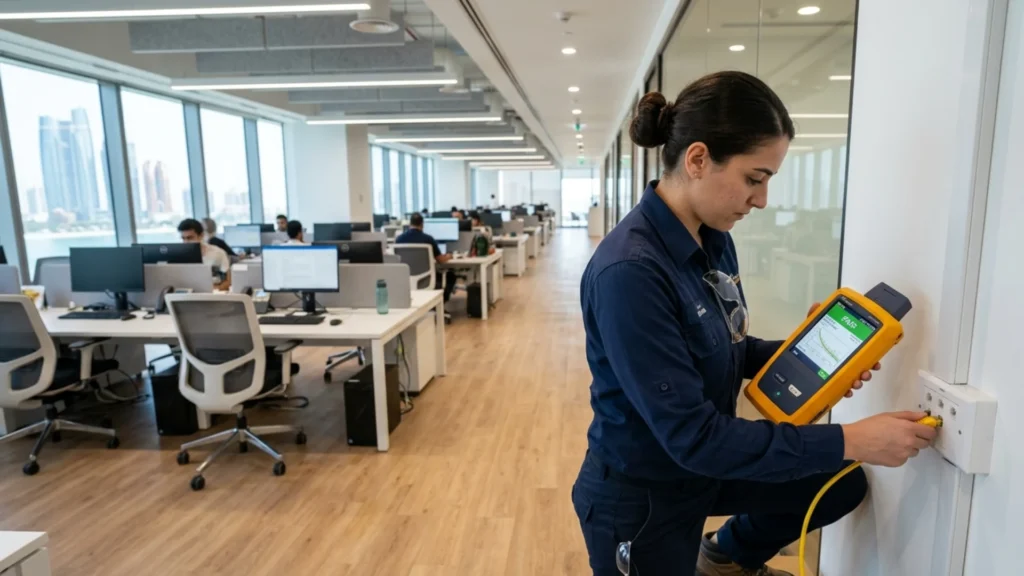
Choosing a structured cabling contractor in Abu Dhabi is one of the most consequential decisions on any fit-out or construction project. Unfortunately, the wrong choice creates problems that stay hidden inside your walls until the day your network fails. By then, the cost of fixing them is always significant. Therefore, before you appoint any contractor, ask these questions without exception and accept nothing less than a complete answer.
Are They BICSI Certified?
BICSI certification is the most recognised qualification in structured cabling globally. A BICSI-certified designer and installer follows a documented methodology, uses correct installation techniques, and produces professional documentation. Ask for the certification number and verify it directly.
Do They Provide Fluke-Certified Testing?
Every structured cabling run should be tested using a Fluke DSX cable analyser or equivalent, and every test result should be included in the project documentation. This is the only way to prove that each cable run performs to the standard it was installed for. A contractor who does not offer Fluke-certified testing is asking you to take their word for it.
What Documentation Do They Deliver?
Professional structured cabling contractors in Abu Dhabi deliver a full set of as-built drawings, a cable schedule with every run labelled and mapped, and a complete set of test reports. This documentation is essential for any future moves, additions, or changes to your network. Without it, you are starting from scratch every time.
Have They Worked on Projects of Similar Scale?
A contractor experienced in small office fit-outs may not have the project management capability for a 20-floor commercial tower. Ask for references from projects of a comparable size and complexity to yours, and follow up on them.
Do They Understand ELV Integration?
In Abu Dhabi, structured cabling rarely sits in isolation. It connects to CCTV, access control, AV, and building management systems. A contractor who understands the wider ELV environment designs cabling that works across all of those systems from day one, rather than creating conflicts that surface during commissioning.
As an ELV integration company in Abu Dhabi, MYB Advanced Technology Systems designs structured cabling systems that are built for the full technology ecosystem of your building, not just the data network.
Structured Cabling for Specific Sectors in Abu Dhabi
Structured cabling requirements are not identical across all sectors. Here is how they differ across the industries we serve most commonly in Abu Dhabi.
Corporate Offices
Corporate office cabling in Abu Dhabi focuses on density, flexibility, and future-proofing. Open-plan offices with hot-desking, wireless coverage grids, and video conferencing infrastructure all place specific demands on the cabling design. Cat6A as a minimum, with fiber to the floor for multi-story buildings, is the standard we recommend for any new corporate fit-out.
Healthcare Facilities
Hospitals and clinics in Abu Dhabi require structured cabling that supports clinical systems, nurse call, IP telephony, patient entertainment, and building management simultaneously. Redundancy, cable routing that avoids interference with medical equipment, and strict documentation for regulatory compliance are non-negotiable in healthcare environments.
Government and Institutional Buildings
Government facilities in Abu Dhabi often specify additional requirements around cable fire ratings, containment types, and documentation standards. These projects also frequently require integration with security infrastructure as part of a wider smart building automation strategy.
Hospitality and Retail
Hotels and retail environments require cabling that supports guest WiFi, point-of-sale systems, digital signage, and back-of-house operations, all from a single unified infrastructure. Reliability and aesthetics both matter in these environments, which means containment and cable management need as much attention as the cabling itself.
The Structured Cabling Installation Process: What to Expect
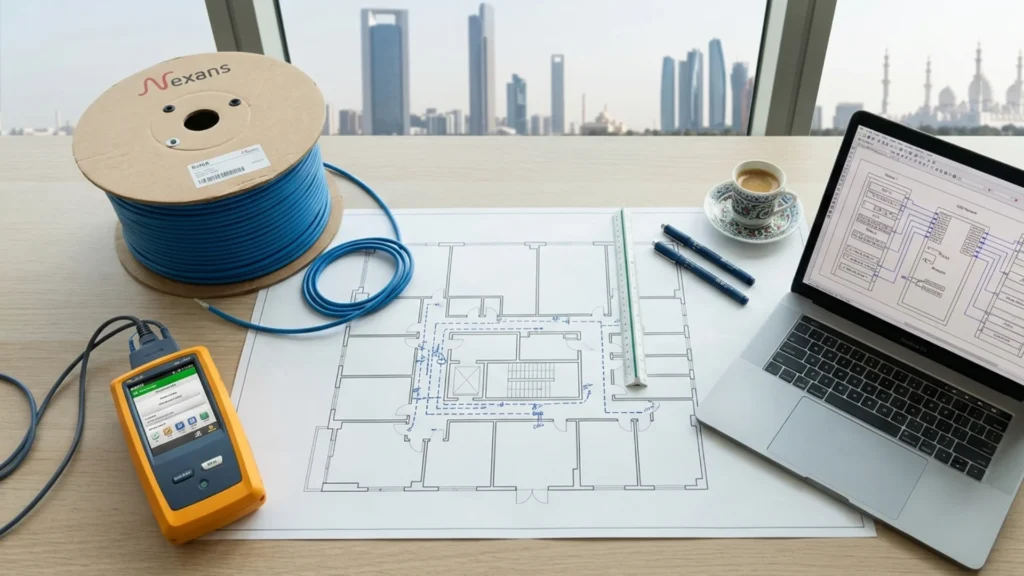
Understanding the installation process helps you plan your project timeline and avoid surprises. A professional structured cabling installation in Abu Dhabi follows a consistent sequence of stages.
Stage 1: Site Survey and Design
The process begins with a detailed site survey. A qualified engineer walks the property, assesses the building structure, identifies the optimal routing for cable containment, and maps every work area, equipment room, and distribution point. From this survey, a cabling design is produced that shows every cable run, every termination point, and the full bill of materials.
Stage 2: Containment Installation
Before any cables are pulled, the containment system goes in. This includes cable trays, conduits, trunking, and floor or ceiling voids depending on the building type. Containment is the skeleton of your cabling system, and it must be sized correctly for the current cable count and for future expansion.
Stage 3:Cable Pulling and Termination
Installers pull cables through the containment system and terminate them at both ends. The team labels every cable at the point of pull and at every termination point along the route. Engineers then install and label patch panels in the equipment room and face plates or outlets in the work areas, following the cable schedule precisely.
Stage 4: Testing and Certification
The engineer tests every cable run using a Fluke DSX cable analyser. This test verifies that each run meets the performance specification of the cable category installed. If any run fails, the team investigates the cause, fixes the issue, and retests until the run passes. Consequently, you receive a full set of pass reports covering every single cable in the building.
Stage 5: Documentation and Handover
On completion, your contractor hands you a full set of as-built drawings, a cable schedule, and all test reports. This documentation serves as your permanent record of every cable, every route, and every termination point in the building. Moreover, it allows any qualified contractor to add, move, or change anything in the future without guesswork, saving you significant time and money on every future project.
Frequently Asked Questions About Structured Cabling in Abu Dhabi
What is the difference between Cat6 and Cat6A for Abu Dhabi offices?
Cat6 supports speeds up to 1 gigabit per second over 100 metres. Cat6A supports 10 gigabits per second over the same distance. For any new installation in Abu Dhabi today, Cat6A is the recommended choice because it future-proofs your investment. The cost difference between Cat6 and Cat6A is modest compared to the cost of recabling in five years.
How long does structured cabling installation take in Abu Dhabi?
A small office with 20 to 30 data points typically takes 3 to 5 working days to complete. Medium commercial fit-outs of around 100 data points generally take 2 to 4 weeks. Larger projects run in phases coordinated with the overall fit-out programme. In all cases, your contractor should provide a detailed programme at the very start of the project.
Do I need structured cabling if I am using wireless networking?
Yes. Wireless access points connect to the network through a structured cabling system. Every access point requires a data point and power over ethernet, both of which come from the cabling infrastructure. Wireless is the last metre of connectivity. Structured cabling is everything behind it.
Can structured cabling carry CCTV and access control signals?
Yes. IP-based CCTV cameras and access control readers connect to the network using the same Cat6A infrastructure as your computers and phones. A well-designed structured cabling system accounts for all of these devices from the start, which is why integrated ELV design is always more efficient than designing each system separately.
How many data points does my Abu Dhabi office need?
A standard rule of thumb is two data points per workstation, one for a computer and one for an IP phone or spare, plus additional points for wireless access points, printers, and meeting room AV equipment. A 50-person office typically requires between 120 and 160 data points in total when all devices are accounted for.
What warranty should I expect on a structured cabling installation?
A professional structured cabling installation in Abu Dhabi should carry a minimum 15-year system warranty covering both materials and workmanship. Manufacturers such as Nexans, Belden, and Panduit offer these warranties directly to contractors they certify. Therefore, always ask your contractor for the warranty certificate on handover and confirm it covers both parts and labour.
Is structured cabling required for ADMCC-compliant CCTV systems in Abu Dhabi?
A structured cabling infrastructure significantly simplifies ADMCC-compliant CCTV installation because it gives every IP camera a tested and documented connection pathway. While ADMCC does not mandate structured cabling specifically, any CCTV system that sits on a professional cabling infrastructure wins approval faster, costs less to maintain, and scales more easily when your business grows.
Why Abu Dhabi Businesses Choose MYB for Structured Cabling
MYB Advanced Technology Systems designs and installs structured cabling systems across Abu Dhabi for corporate offices, government facilities, healthcare buildings, hospitality projects, and industrial sites.
Every project starts with a professional site survey and a fully designed cabling plan. No work begins until that plan is approved. We install using internationally certified materials from partners including Nexans. We test every single cable run with a Fluke DSX analyser. On completion, you receive full test reports, as-built drawings, and a complete cable schedule.
Moreover, our team understands the wider ELV environment in Abu Dhabi. As a result, we design your cabling system to carry not just your data network but also your CCTV, access control, AV, and building management signals. Everything runs from one coordinated infrastructure, which saves cost and eliminates conflicts between systems.
contact our team today to arrange a free site survey for your Abu Dhabi project. We will assess your requirements, produce a cabling design, and give you a clear and fully itemised quotation with no obligation.